
Real Estate Website Design: 10 Must-Have Features That Win Buyers
Real estate website design is different from almost any other kind of web design. A buyer may spend weeks browsing before making one phone call, and that call can lead to the biggest purchase of their life. Your website has to earn their trust long before you ever meet them: it must show every property beautifully, answer their questions honestly and make it effortless to get in touch.
I build and look after the website of a real estate company in Famagusta, North Cyprus, in four languages. Here are the ten features I have found a real estate website truly needs, and why each one matters.
1. Property listings that sell
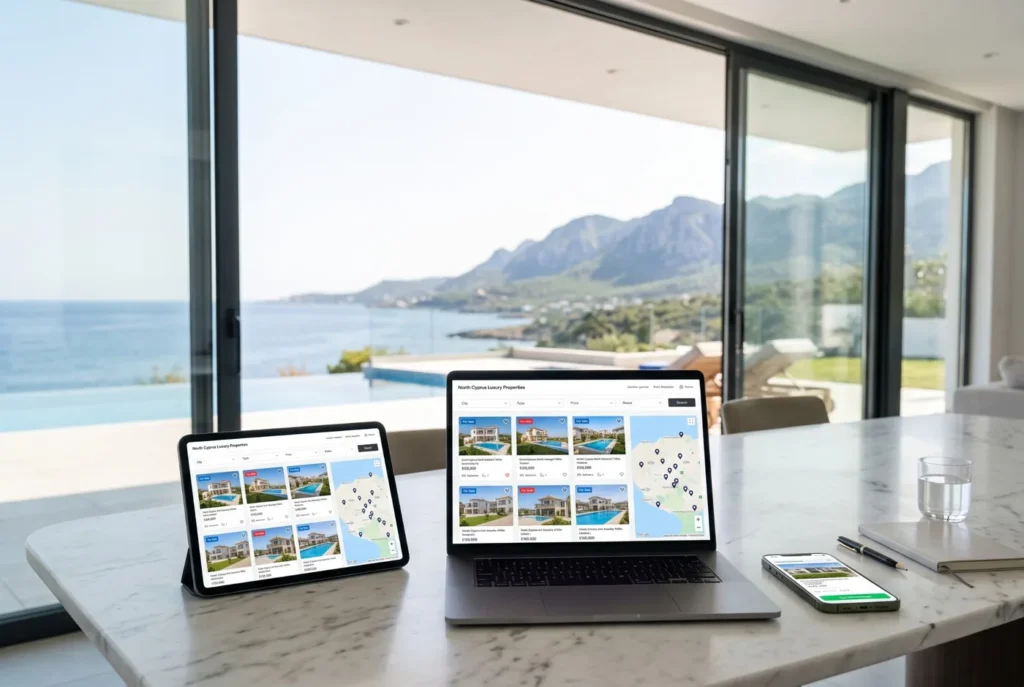
Each property deserves its own page, with everything a buyer needs at a glance: price, location, size, number of bedrooms and bathrooms, and a clear description. Small details make a big difference. Status labels such as For Sale, Sold or Off-Plan, badges for payment plans and a reference number for each listing help buyers compare quickly and help your team know exactly which property a visitor is asking about.
2. Photos and video that do the property justice
In real estate, photos are the product. Use large, bright, professional images, a smooth gallery that works with a swipe on a phone, and video tours where you have them. Floor plans are a bonus that serious buyers love. The trick is to deliver all this quality without slowing the site down, which brings us to speed later in this list.
3. Search and filters that feel effortless
Buyers rarely browse everything. They search by city, property type, price range, number of bedrooms or status. Give them a clear search form and quick filters for your most popular areas, so they reach the right homes in two or three taps. On the site I work on, buyers can filter by category, type, city and status, and jump straight to areas such as Kyrenia, Iskele, Nicosia and Famagusta, or to off-plan projects.
4. An interactive map
Location is everything in property, so show it. An interactive map with your listings lets buyers see where each home is, how close it is to the sea, the city centre or a university, and which other properties are nearby. For buyers who live abroad and cannot visit easily, a map is often the moment a listing starts to feel real.
5. Every language your buyers speak
Property buyers are often international. Speaking to them in their own language is one of the strongest trust signals you can give. Each language should be a proper translation with its own address, such as /de/ or /fa/, so it can rank on Google in that market. Persian and Arabic need a true right-to-left layout, not a mirrored English page. With WordPress and WPML, every page, menu, property and article can be managed in several languages from one dashboard.
6. Fast on every phone
Property websites are heavy by nature: hundreds of photos, maps, videos and search forms. Many visitors open them on a phone from a link in WhatsApp or social media, so speed matters. Modern WebP images, lazy-loading, page caching, a CDN and removing scripts that a page does not need can make a rich property site fast without changing its look. I describe this process in detail in How I Took a Multilingual WordPress Site to 90+ on Google PageSpeed.
7. Contact on every listing
When a buyer falls in love with a property, the next step should be one tap away. Put a WhatsApp button, a phone number and a short enquiry form on every listing, ideally with the property reference already filled in. Make your office address, opening hours and map easy to find on every page. The fewer steps between interest and conversation, the more enquiries you will receive.
8. Content that answers buyers’ questions
Buyers, especially from abroad, have many questions before they feel ready: How does the buying process work? Which area suits a family, a student or an investor? What do the legal steps involve? Area guides, a clear buying guide and regular blog articles answer these questions, build trust and bring in visitors from Google long before they are ready to call. Keep this content accurate and up to date, because property rules and procedures can change.
9. SEO built in from the start
A real estate website lives on search. A few foundations make a real difference:
- Unique titles and descriptions for every property, area page and article
- Clean, readable addresses for each listing and each language
- Structured data and sitemaps for every language, for example with Rank Math
- Internal links between listings, area guides and articles
- A complete Google Business Profile and Bing Places listing for local search
- Google Search Console, to see how buyers find you and fix problems early
10. Trust, and a site that is easy to manage
Buyers want to know who they are dealing with. Clear company details and registration, real photos of your team and office, honest reviews and simple privacy and legal pages all build confidence. Behind the scenes, your team should be able to add a new property, change a price or mark a home as sold in minutes, without waiting for a developer. A WordPress real estate theme such as WPResidence, combined with Elementor, makes this straightforward, while regular updates, backups and security checks keep everything healthy.
Real estate website checklist
- ✔ A full page for every property, with status labels and a reference number
- ✔ Large, fast-loading photo galleries and video tours
- ✔ Search by city, type, price, bedrooms and status
- ✔ An interactive map of your listings
- ✔ Every language your buyers speak, with right-to-left where needed
- ✔ Fast loading on phones
- ✔ WhatsApp, phone and an enquiry form on every listing
- ✔ Area guides, a buying guide and an active blog
- ✔ SEO foundations in every language
- ✔ Clear trust signals and an easy dashboard for your team
Frequently asked questions
Is WordPress a good choice for a real estate website?
Yes. With a dedicated real estate theme, WordPress handles listings, search, maps and multiple languages, and your team can manage properties from a friendly dashboard. You can read more in Why WordPress Is Still the Best Choice for Business Websites.
How many languages should a property website have?
Start with the languages your buyers actually speak. Look at where your enquiries come from, then add languages one by one, each with a proper translation rather than an automatic one.
Can a property website with many photos still be fast?
Yes. Modern image formats, lazy-loading, caching and a CDN let you keep large, beautiful photos while pages still load quickly, even on a phone.
Does a real estate agency also need a mobile app?
A strong website comes first, because that is how buyers find you on Google. An app can be a great next step for saved searches, alerts for new listings and staying in touch with returning clients. Take a look at my real estate app concept and my guide to Flutter app development.
Want to see all of this in a real project? Read the Luxury Life Property case study, a four-language real estate website with a full right-to-left Persian version. If your business is based here, you may also like Website Design in North Cyprus: What a Business Website Really Needs.
Planning a new property website, or want your current one to bring in more enquiries? Get in touch and tell me about your agency. I would be glad to help.